


Good sectioning is the foundation of beautiful real dreads. It determines how your dreads fall, how strong they stay and how full your hairstyle looks.
You'll wear your sections for as long as you have your dreads, so it's worth thinking them through beforehand. In this blog, you'll read what to look for and what happens when sections are too big or too small.
Why is sectioning so important?
- A sturdy base. Each section carries the weight of one dread. With enough hair in the section, your dread stays strong and is less likely to break off.
- Dreads that fall beautifully. The shape and placement of your sections determine how your dreads lie on your head.
- A healthy scalp. When each dread has its own section, your dreads are less likely to grow together and your scalp is easier to keep clean.
- Easier maintenance. With clear sections, it's easy to see which new growth belongs to which dread.
How big should the sections be?
There's no set size, because it really differs per person. It depends on the thickness and structure of your hair, the length and the number of dreads you want.
Do you have fine hair and want thick dreads? Then you'll definitely need larger sections. Would you rather have more dreads? With triangles you can reach a little more, and you can still make quite a lot of dreads with fine hair.
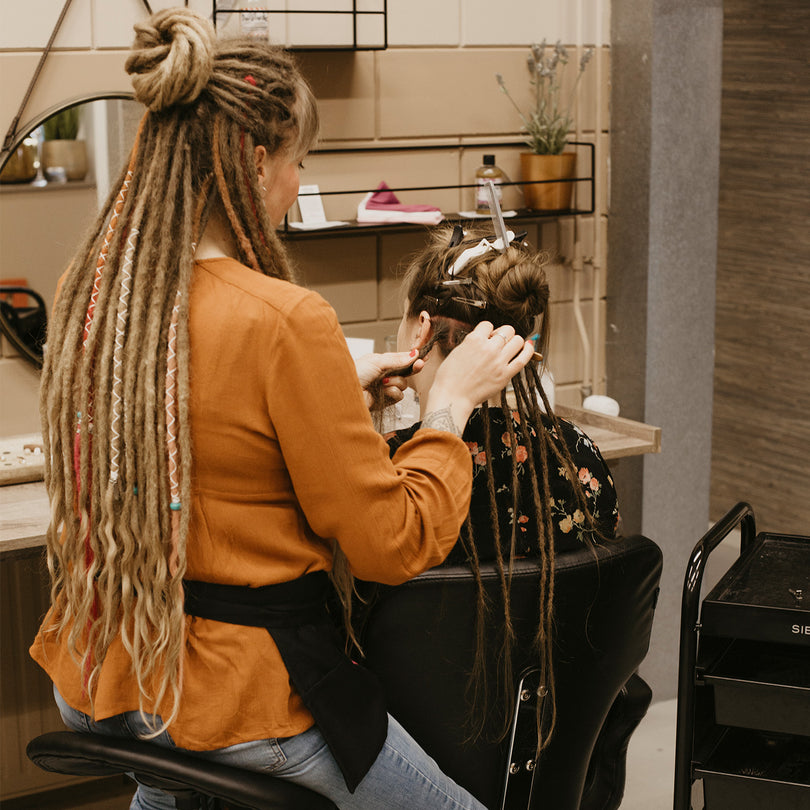
In our Salon, we first look at and feel your hair. Then we decide together which sectioning suits you.
Squares and triangles
By combining squares and triangles, you can make more dreads and they fall more beautifully. Because they fall so naturally, your hairstyle also looks fuller.
In our Salon, we work with our own special sectioning. It falls beautifully and above all is very comfortable, so your scalp stays healthy. Are you a professional or do you want to become one? We explain this sectioning in full in our Professional Real Dreadlock Stylist course.
Sectioning with thin hair
With thin hair, the right sectioning really makes a difference. Your dreads won't be as full as with thick hair, but they do get fuller over time, because the hairs you lose every day stay inside your dreads.
I have fine, thin hair myself. By letting go of my expectation of a huge head of dreads and choosing the right sectioning, I had a gorgeous head of real dreads. Read more in real dreads with thin hair.

Sectioning with partial dreads
With partial dreads, only part of your hair is dreaded, usually at your neck or the back of your head. Here, the sections also determine where your loose hair begins. Many customers start this way and gradually expand step by step. Read why starting with partial dreads can be a great choice.
What if the sections aren't right?
- Too small: there's little hair at the base, while it still has to carry the weight of your dread. That can make hairs come loose and your dread can break off.
- Too big: you get fewer, very thick dreads that fall less naturally. Your scalp and the inside of your dreads are harder to keep clean, so you're also more likely to get scalp irritation.
Can you change your sectioning later?
You can, but it isn't always easy. Are your dreads getting thin at the roots? Then you can merge two thin dreads into one stronger dread. A more drastic option is to comb out your dreads and start again with larger sections. Read what you can do about thin roots.
Get good advice
Not sure which sectioning suits you? Book a no-obligation consultation, in our Salon or online by video call. Together, we'll look at what's possible with your hair.
-X- Renate